How to Build an AI-First Company in 90 Days: A Practical Roadmap

You can give every employee an AI assistant tomorrow and still have missed customer follow-ups, duplicated work, scattered information and painfully manual reporting. You can automate tasks while managers still chase people for updates. You can deploy sophisticated AI while routine decisions continue finding their way back to the business owner.
That is because using AI and becoming an AI-first company are two very different things. An AI-first company is a business designed to use reliable data, connected processes, automation and artificial intelligence to improve how people work, make decisions and serve customers. AI supports human capability rather than replacing human accountability.
In my work helping businesses transform, I have learned that technology rarely fixes a fundamentally disorganised business. It usually exposes its weaknesses. This thinking also sits behind my newly released 9th book, Build an AI-First Company in 90 Days, which holds that successful AI transformation starts with the business, not the technology.
An AI-first company is designed to use information, processes, automation and intelligence to operate better. AI becomes part of how the organisation works, rather than another collection of tools employees occasionally use. If you want to build an AI-first company, start by checking where you stand with our free AI readiness assessment.
And you do not need to transform your entire company at once. Over the next 90 days, you can start with one important business problem, strengthen the foundations beneath it, redesign the process and prove measurable value.
Do that successfully, and you have something far more valuable than another AI experiment. You have the beginnings of an AI-first company.
What an AI-First Company Actually Looks Like
An AI-first company is not the business with the most AI tools. It is the business where people, processes, information and technology work intelligently together.
That distinction matters. Giving employees access to generative AI may improve individual productivity, but it does not automatically transform how the organisation operates. An AI-first business builds the foundations that allow intelligence to flow through everyday work.
In practical terms, it:
- Captures reliable operational data rather than relying on assumptions and fragmented records.
- Runs through clear, repeatable processes instead of depending on individual memory.
- Connects information across departments so employees can access what they need.
- Automates predictable work that does not require human judgement.
- Uses AI to support decisions, interpretation, analysis, communication and knowledge work.
- Maintains clear human accountability for decisions and outcomes.
- Continuously learns and improves using operational and customer data.
Think of AI as an amplifier. A guitarist still needs a guitar, electricity and something worth playing before an amplifier becomes useful. AI cannot amplify capabilities your business has never properly built.
AI-First Does Not Mean AI-Only
This is an important principle from the outset. The objective is not to remove people from the business. It is to remove unnecessary work from people so they can contribute where human capability matters most.
People should remain responsible for relationships, judgement, creativity, leadership, sensitive decisions and unusual exceptions. AI can provide intelligence and recommendations, but accountability cannot simply be delegated to an algorithm.
The goal of any sound AI business strategy, therefore, is not maximum automation but the right combination of human judgement, reliable information, intelligent automation and AI working as one business system.
Why AI Transformation Fails Before the AI Does
Many AI initiatives fail for a surprisingly simple reason: businesses start with the technology instead of the problem. A new AI tool appears. Someone signs up. A few employees experiment with it. Management gets excited about the possibilities, and suddenly everyone is looking for places to use AI.
The sequence often looks like this: Buy the tool → Find a use case → Experiment → Hit data and process problems → Struggle with adoption → See little measurable value → Try another tool.
The technology may work perfectly. The business system around it does not. Perhaps customer information lives across spreadsheets, inboxes and different applications. Maybe nobody owns the process being automated. Employees may perform the same task differently, while critical knowledge sits inside people's heads.
Adding AI does not remove these weaknesses. In many cases, it magnifies them.
Technology magnifies the quality of the system beneath it. If the foundations are weak, AI can simply make confusion move faster.
Consider automating customer follow-ups. If your CRM contains incomplete information, lead stages are unclear and nobody owns the next action, AI will not magically create a reliable sales process. This is why an AI-first transformation should not begin with the question, "Which AI tools should we implement?"
A far more useful question is: "Which business problem are we trying to solve, and what needs to change before AI can help us solve it?"
That shift takes you away from AI experimentation and towards measurable business transformation.
The First Commitment: Solve One Valuable Business Problem
One of the biggest mistakes leaders make with AI transformation is trying to transform everything simultaneously. The ambition sounds impressive, but the scope quickly becomes unmanageable.
Instead, make what I call the first commitment: choose one recurring business challenge or opportunity worth solving properly. Look for a problem that happens frequently and has a measurable impact on customers, employees, costs or revenue.
For example:
- Sales leads are not followed up quickly enough.
- Customer enquiries take too long to resolve.
- Quotes require unnecessary manual work.
- Managers wait days for performance reports.
- Employees repeatedly search for information they should easily find.
- Routine decisions keep escalating to the business owner.
Then ask one powerful question: If we solved one recurring problem properly in the next 90 days, which one would create the greatest measurable value?
Do not start with the whole company. Start with one revenue line, customer journey or operational process where the impact can be observed and measured.
This creates focus. It also changes the conversation from "Where can we use AI?" to "How can we build a better way of working?" AI may eventually become part of the solution. Automation might play a bigger role. Sometimes the greatest improvement may simply come from fixing the process first.
The discipline is simple: One problem. One process. One accountable owner. One measurable outcome.
Solve that well, and you have something valuable to scale. More importantly, you have started building the organisational muscle required to become AI-first.
Build the Foundations Before You Build the AI
Once you have chosen the problem, resist the temptation to start automating immediately.
First, examine the business foundations beneath that problem. AI performs best when it operates inside a business that already knows what it wants to achieve, how work should flow and who remains accountable.
I recommend examining seven connected foundations:
| # | Foundation | Question to answer |
|---|---|---|
| 1 | Strategy | What measurable business outcome are we trying to improve? |
| 2 | Customers | Where are customers experiencing friction, delays or inconsistency? |
| 3 | Processes | How does the work actually happen today? |
| 4 | Data & Infrastructure | Do we have reliable, accessible and connected information? |
| 5 | Automation & AI | What should people, automation and AI each handle? |
| 6 | People & Culture | Do employees understand and support the new way of working? |
| 7 | Governance & Control | Who controls access, quality, exceptions and accountability? |
These foundations cannot be treated independently. For example, automating a poorly designed process simply makes inefficiency happen faster. AI working with unreliable data can produce confident but unreliable outputs. Great technology with poor employee adoption becomes expensive shelfware.
The same applies to governance. Someone still needs to decide what AI can access, which decisions require human approval and what happens when something goes wrong.
Think of these foundations as the runway. AI may provide considerable thrust, but sophisticated engines are useless without somewhere safe to take off.
This is why becoming AI-first is ultimately an AI business transformation challenge, not merely a technology implementation project — and why it belongs inside your wider digital transformation roadmap. Your objective is to create a sufficiently strong operating environment where people, processes, data, automation and AI can work together reliably.
Once those foundations are understood, you are ready to turn the first commitment into a focused 90-day transformation.
The 90-Day AI-First Roadmap
The next step is to turn the first commitment into a focused transformation cycle. This AI implementation roadmap is built for AI transformation for SMEs: the goal is not to "implement AI" in 90 days but to improve one important business process, prove measurable value and create a method you can repeat elsewhere.
Days 1–30: Assess and Align
The first 30 days are about understanding the current state before changing it. Start by selecting the priority revenue line, customer journey or operational process. Then define the business problem in concrete terms.
Map how the work currently moves between people, systems and departments. Look for delays, duplication, manual handovers, missing information and unnecessary approvals.
Key activities include:
- Define the business problem clearly.
- Map the existing process from start to finish.
- Identify bottlenecks and repeated work.
- Review the systems and data involved.
- Assess where decisions keep escalating unnecessarily.
- Establish baseline performance measures.
- Assign one accountable process owner.
This stage matters because weak diagnosis produces weak transformation.
Outcome: A clearly defined improvement opportunity with an agreed baseline.
Days 31–60: Design and Pilot
Now redesign the process before automating it. Documented processes make business process automation far more reliable. This is where you decide which parts of the workflow should be handled by people, automation or AI.
A useful distinction is: Human-led → Automated → AI-assisted → Escalated
Routine, rules-based work may be automated. AI can support analysis, classification, drafting and interpretation. People should remain involved where judgement, relationships or exceptions matter.
During this phase:
- Redesign the workflow.
- Remove unnecessary steps.
- Connect the required information.
- Define exception and escalation routes.
- Build a controlled pilot.
- Train the people involved.
- Test outputs, controls and safeguards.
The pilot should operate inside a real process, not just in a demonstration environment.
Outcome: A functioning AI-enabled workflow applied to real work.
Days 61–90: Implement, Measure and Improve
The final phase moves the pilot into daily operations. Monitor how people actually use the new process. Compare results against the baseline established during the first 30 days.
Pay attention to:
- Adoption
- Speed
- Quality
- Exceptions
- Customer impact
- Commercial results
Fix weaknesses before expanding the solution. Document responsibilities, controls, lessons and new operating procedures. Then make an evidence-based decision:
Improve it. Expand it. Replicate it. Or stop it.
That last option matters. Not every experiment deserves to scale.
Outcome: A measurable business improvement and a repeatable transformation method.
By Day 90, the real achievement is not that the company has "used AI." But that the business has learnt how to identify a valuable problem, redesign the work around it and use technology intelligently to create measurable improvement.
What This Looks Like in a Real SME
Consider a common customer-enquiry process. Before transformation, an enquiry arrives through email, a website form or social media. Someone manually records it, forwards it to another employee and waits for a response.
Follow-up depends on memory. Information is duplicated across systems. Nobody has complete visibility. When the process stalls, the owner or manager gets involved.
That may look like a people problem. In reality, it is usually a process, information and accountability problem. After transformation, the same journey can look very different:
Enquiry received → Automatically captured → Classified → Assigned → AI-assisted response prepared → Human review where required → Follow-up tracked → Performance measured
Now the business has structure around the work.
AI can help classify the enquiry, summarise context or draft a suitable response using approved information. Automation can route the case, trigger reminders and update records. Employees can focus on exceptions, judgement and customer relationships. Managers gain visibility into response times, conversion rates and unresolved cases without waiting for manual reports.
The important point is this: The value does not come from the AI-generated response alone.
The real transformation — and the real value of AI automation for business — comes from redesigning the complete process so that information, automation, accountability and intelligence work together. That is what makes the business more scalable.
And that is what an AI-first company should actually look like in practice.
Measure Business Improvement, Not AI Activity
Use clear dashboards to track the impact — see how business analytics and executive dashboards support AI for SMEs.
One of the easiest ways to get AI transformation wrong is to measure activity instead of outcomes. The number of AI tools introduced tells you very little. So does the number of employees using prompts, agents or copilots, or even token maxing (AI token maxing refers to the practice of artificially inflating AI token usage to manipulate workplace performance metrics or project a false sense of high productivity).
What matters is whether the business performs better.
A useful AI-first scorecard should be used to track a small number of measures linked directly to the problem you chose. Depending on the process, these might include:
- Response time – are customers getting answers faster?
- Process completion time – is work moving through the business more quickly?
- Conversion or resolution rate – are more opportunities being converted or closed?
- Error and rework rate – has quality improved?
- Manual hours removed – how much repetitive effort has been eliminated?
- Employee adoption – are people actually using the new process?
- Management intervention – are fewer routine issues escalating to leaders?
- Revenue impact – has the change protected, accelerated or created revenue?
The baseline established during the first 30 days becomes critical here. Without it, improvement becomes a matter of opinion. And opinion is a poor transformation metric.
The question you should ask here is: "What business improvement has AI helped us achieve?" That is the difference between chasing technology trends and building a more capable company.
Day 90 Is the Beginning, Not the Finish Line
If the first 90 days go well, you should end with more than one successful AI use case. You should have built a stronger operating capability.
The business should now have:
- A clearer process.
- Better-quality information.
- A tested automation and AI use case.
- More confident employees.
- Defined governance and controls.
- A practical way to measure results.
More importantly, you now have a method that can be repeated. That matters because AI transformation should not be treated as a once-off project. It should become part of how the company improves itself.
Your next move may be to refine the first process further. Or you may apply the same method to another customer journey, revenue line or operational bottleneck. This is where momentum starts to build. The second transformation cycle is usually easier because the business has already learned how to diagnose a problem, redesign the workflow, introduce technology and measure impact.
Over time, these cycles begin to compound into a genuinely AI-powered business and a repeatable AI adoption strategy. One improved process becomes several. Better data improves decision-making. Employees become more comfortable working with automation and AI. Leaders gain better visibility into performance.
That is how an SME starts moving from isolated AI experiments to becoming genuinely AI-first. Not by transforming everything at once. By building one measurable improvement, then repeating the process with greater confidence and discipline.
Conclusion: Make the First Commitment
For the full method, read the book AI-First Company, or get hands-on support through our enterprise implementation services.
You do not need to transform your entire company today. You need to choose one important problem and commit to solving it properly. That means understanding the process, fixing weak foundations, clarifying ownership, connecting the right information and then applying automation and AI where they create real value.
Start small. Build the foundations. Prove the value. Then scale what works. That is how AI transformation becomes practical. And that is how an SME can begin building an AI-first company in 90 days.
Key Takeaways
- AI-first does not mean AI-only. Human judgement, accountability and relationships still matter.
- Start with the business problem, not the technology.
- Fix the foundations before adding automation and AI.
- Use one 90-day cycle to prove measurable value.
- Scale what works and repeat the method across the business.
Frequently Asked Questions
What is an AI-first company?
An AI-first company is designed to use data, automation and AI as part of how the business operates and makes decisions.
Can an SME become AI-first in 90 days?
Yes, if the goal is to improve one important process and build a repeatable transformation method.
Do I need to automate the entire business?
No. Start with one recurring problem where improvement can create measurable business value.
What should I measure during the 90 days?
Track outcomes such as response times, conversion rates, errors, manual work removed, customer satisfaction and revenue impact.
Where should AI fit into the process?
Use AI where it improves interpretation, analysis, content generation or decision support. Keep human oversight where judgement and accountability matter.
Is Your Business Ready to Become AI-First?
Start with a Digital Transformation and AI Foundations Assessment to identify gaps in your strategy, processes, systems, data, people and governance.
The goal is simple: determine where AI can create the greatest measurable value.
Start My Assessment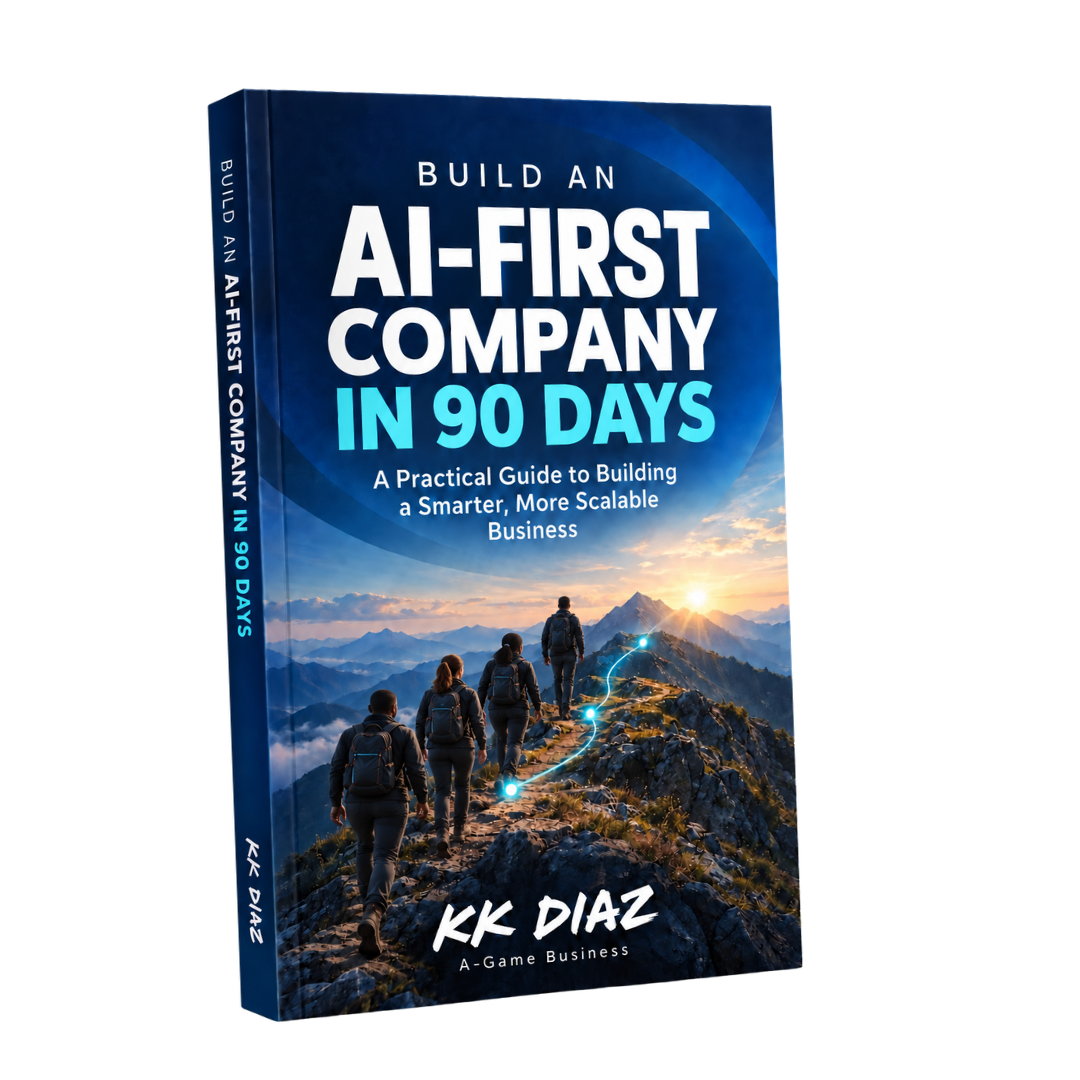
Want the complete framework?
Start a free trial of the A-Game Business Operating System to read Build an AI-First Company in 90 Days and access practical tools for building a smarter, more scalable business.
Read the Book